
Why Quality Heat Pump Installation Costs What It Does

If you're comparing heat pump quotes, you've probably noticed the prices vary quite a bit. It's tempting to go with the lowest number. But when you dig into what's actually included in each quote, the differences become clear. This post is about what separates a properly engineered installation from a budget one, so you can compare quotes meaningfully.
Heat Loss Calculations: The Foundation
Every decision downstream — heat pump size, radiator specifications, underfloor heating layout, pipe spacing — flows from a single piece of work: the heat loss calculation.
A proper heat loss calculation is done room by room, at a design temperature of minus eighteen degrees. It's detailed work. You're measuring every external wall, every window, every door. You're assessing insulation levels. You're factoring in ventilation. The result is a number for each room: how much heat it needs to stay at twenty degrees when it's freezing outside.
That number drives everything. Get it wrong, and you'll either oversize the heat pump (wasting capital and running costs on a unit that cycles too much) or undersize it (and run short on heat on the coldest days). It also determines whether your existing radiators will do the job, or whether you need additional emitters. It tells us how to space the pipes on your underfloor heating to keep flow temperatures as low as possible.
Many installers skip this or do it roughly. They'll estimate based on floor area or use a rule of thumb. It's faster. It's cheaper for them. What it isn't is reliable.
We do this calculation properly because everything else depends on it. It takes time and costs money upfront. It also prevents expensive problems later.

Flow Temperature Design: The Efficiency Lever
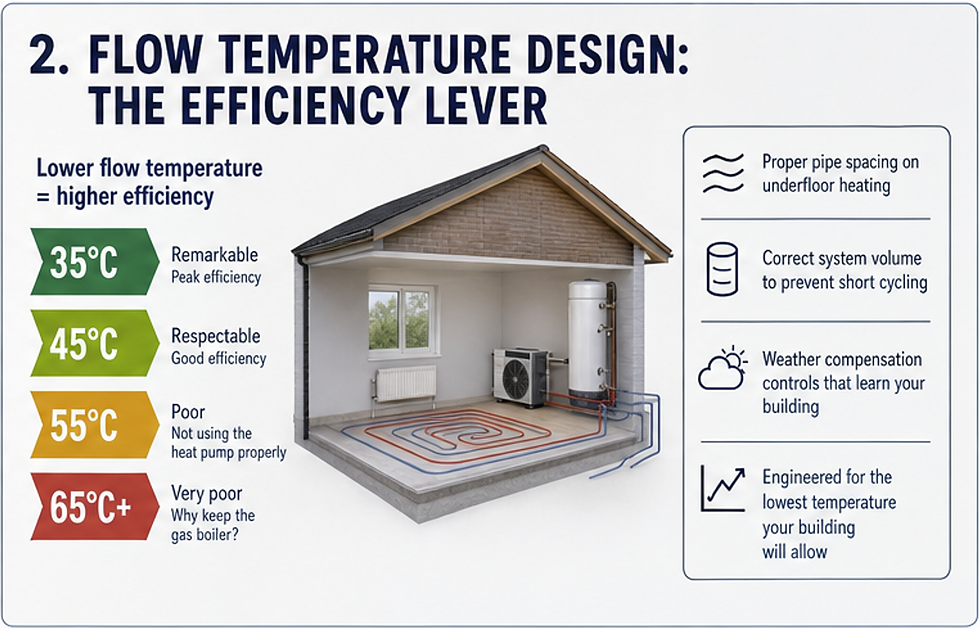
Here's something most people don't realise: the difference between a heat pump that runs at peak efficiency and one that doesn't often comes down to flow temperature.
A heat pump is most efficient when it can deliver heat at the lowest possible temperature. Thirty five degrees flow temperature is remarkable. Forty five degrees is respectable. Fifty five degrees starts to look like you're not using the heat pump properly at all — you might as well have kept the gas boiler.
Getting flow temperature down to thirty five degrees isn't magic, but it does require engineering. It starts with proper pipe spacing on underfloor heating. It requires the right system volume so the heat pump doesn't short cycle. It needs weather compensation controls that learn your building's behaviour over the course of a winter and dial in the optimal temperature curve.
If you're comparing quotes and one promises very low flow temperatures without explaining how, be sceptical. If another quote doesn't mention flow temperature at all, that's a warning sign.
We design systems to achieve the lowest flow temperature your building will allow. That's where the efficiency — and the low running costs — actually come from.
Pipe Material and Fitting Design: Copper vs Multilayer Composite (Multicouche)
You'll see two main pipe materials in quotes: copper and multilayer composite pipe (sometimes called MLCP or Multicouche in France).
The issue with multilayer composite isn't the pipe itself. It's the fittings. When you insert an MLCP fitting into the pipe, the fitting goes inside the bore and reduces the internal diameter at that junction. On every elbow — and a heat pump system has dozens of them — the water has to flow through a narrower section. That creates pressure drop. The circulator pump has to work harder to push water through. And that pump runs twenty four seven, fifty two weeks a year, for the life of the system.
Copper pipework solders or compression fits externally, so the internal diameter stays consistent.
But we go further than that.
We've invested in a powered copper pipe bending machine that can pull swept bends in copper pipe up to thirty five millimetres diameter. Mathematically, a swept bend has one third of the pressure drop compared to a soldered or compression fitting. So on every elbow where it's possible — underfloor heating manifolds, plant room pipework, connections between units — we use swept bends instead of fittings.
It's not glamorous work. But every elbow you eliminate or optimise is less resistance in the system. The pump runs at lower pressure. It uses less electricity. The system performs consistently from installation day through to year twenty.
Budget installers don't have the tooling or the design discipline to do this. They're using fittings that create unnecessary resistance. You pay for the cheaper installation upfront. You pay for the excess pumping power every day afterwards.
Pipe Sizing: Invisible Efficiency
Once you know your heat loss and your flow temperature, you can calculate the flow rate your system needs. That determines pipe diameter.
A lot of installers will use the same size pipe throughout, or undersize to save on material cost. What matters hydraulically is water velocity. Too high a velocity and friction losses skyrocket. Too low and you've bought bigger pipe than you need.
Properly sized pipework is engineered for each section of the system. It keeps water velocity in the optimal range, minimises friction, and means the circulator pump doesn't have to work harder than it needs to.
Again, this is invisible on a quote. You won't see it on a bill of materials. But you'll see it on your electricity bill every month. An undersized system costs you money every single day it runs.

Water Quality: Prevention, Not Cure
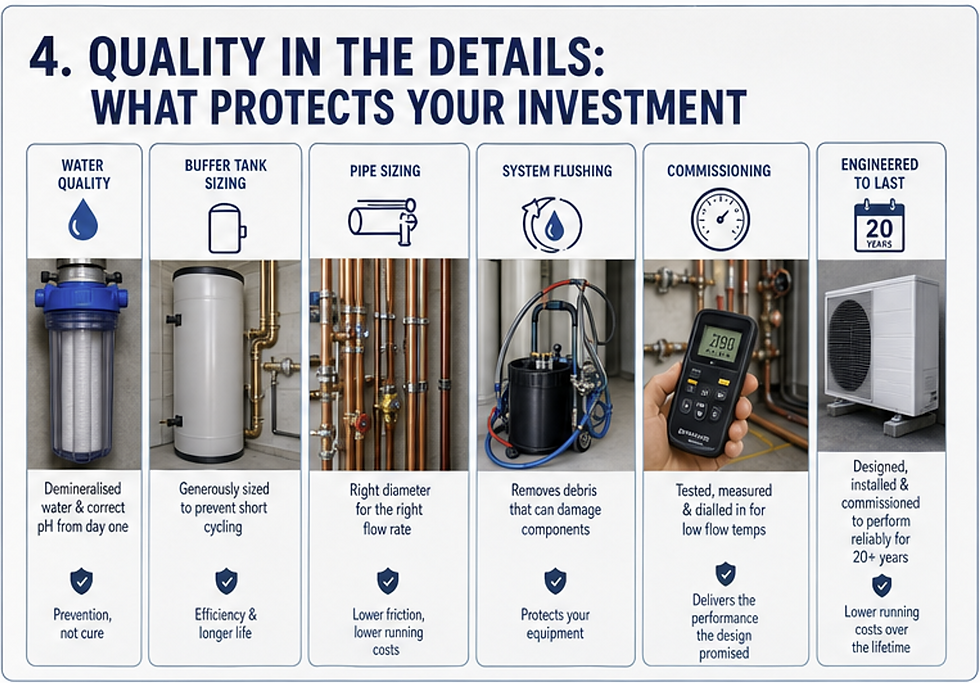
Heat pump systems are closed loops. The water that's in there on day one is the water that circulates for the next twenty years.
Tap water contains minerals and dissolved oxygen. In a closed heating system, those minerals deposit on heat transfer surfaces. The dissolved oxygen causes corrosion inside the pipework and heat exchangers. Once corrosion starts, it doesn't stop. It accelerates. Eventually it damages components beyond repair.
The solution is demineralised water and correct pH balance from the start. It's inexpensive insurance. Most importantly, it works.
Some installers fill systems with tap water to save cost and time. They're betting the system won't corrode, or that any problems won't show up until after their warranty expires. That's not engineering. That's hoping.
We fill every system with demineralised water and test and adjust the pH. We also specify that any top-ups during the life of the system use demineralised water, not tap water. It costs almost nothing but it protects your investment.
Buffer Tank Sizing: System Stability
Heat pumps don't like running in short cycles. When the heating load is small compared to the heat pump's output, it turns on, heats the system quickly, turns off, cools down, turns on again. Repeat ten times an hour. That's short cycling, and it kills both efficiency and compressor life.
The solution is a properly sized buffer or volume cylinder. It gives the system enough water volume that even with low heating loads, the heat pump can run in longer, efficient cycles.
Many installers skip this entirely, or fit a token buffer tank that's too small to do the job. We size buffer tanks based on the building's heat loss and the heat pump's output. Generously. It costs more upfront. It also means your heat pump runs efficiently and lasts longer.
System Flushing and Commissioning: Making Design Reality
You can have the best design in the world, but if commissioning is rushed, you won't get the performance you paid for.
Proper system flushing removes installation debris — swarf from soldering, bits of solder, dust from pipework — before it damages pumps and heat exchangers. It's tedious work, but it protects your equipment.
Proper commissioning means actually testing the system, measuring flow rates and temperatures, and dialling in the weather compensation curve so the system delivers the low flow temperatures the design promised. It takes time. It's worth it.
Budget installers often skip the detailed flushing and do a quick commissioning. They'll get the system running. They won't necessarily get it running optimally.
The Real Comparison
When you're comparing quotes, don't just look at the price. Ask what's included. Ask about heat loss calculations. Ask about flow temperature targets. Ask about pipe sizing and material choices. Ask about water quality and buffer tank sizing. Ask about flushing and commissioning procedures.
The cheaper quote might be leaving things out. Or it might just be more efficient than ours — that's possible, though I'd be curious to understand how.
But more likely, the differences in price reflect differences in approach. We design and engineer systems. We invest in tooling and training. We spend time getting things right. That costs more upfront.
What you get in return is a system that runs efficiently, lasts reliably, and costs less to operate over its lifetime. When you're comparing quotes, that's what's actually worth comparing.


Comments